Knife guide · 5 min read
How to Sharpen a Serrated Knife (Step by Step)
Yes, you can sharpen a serrated knife. Here is the right tool, the step-by-step method, and how to tell when your bread knife needs it.
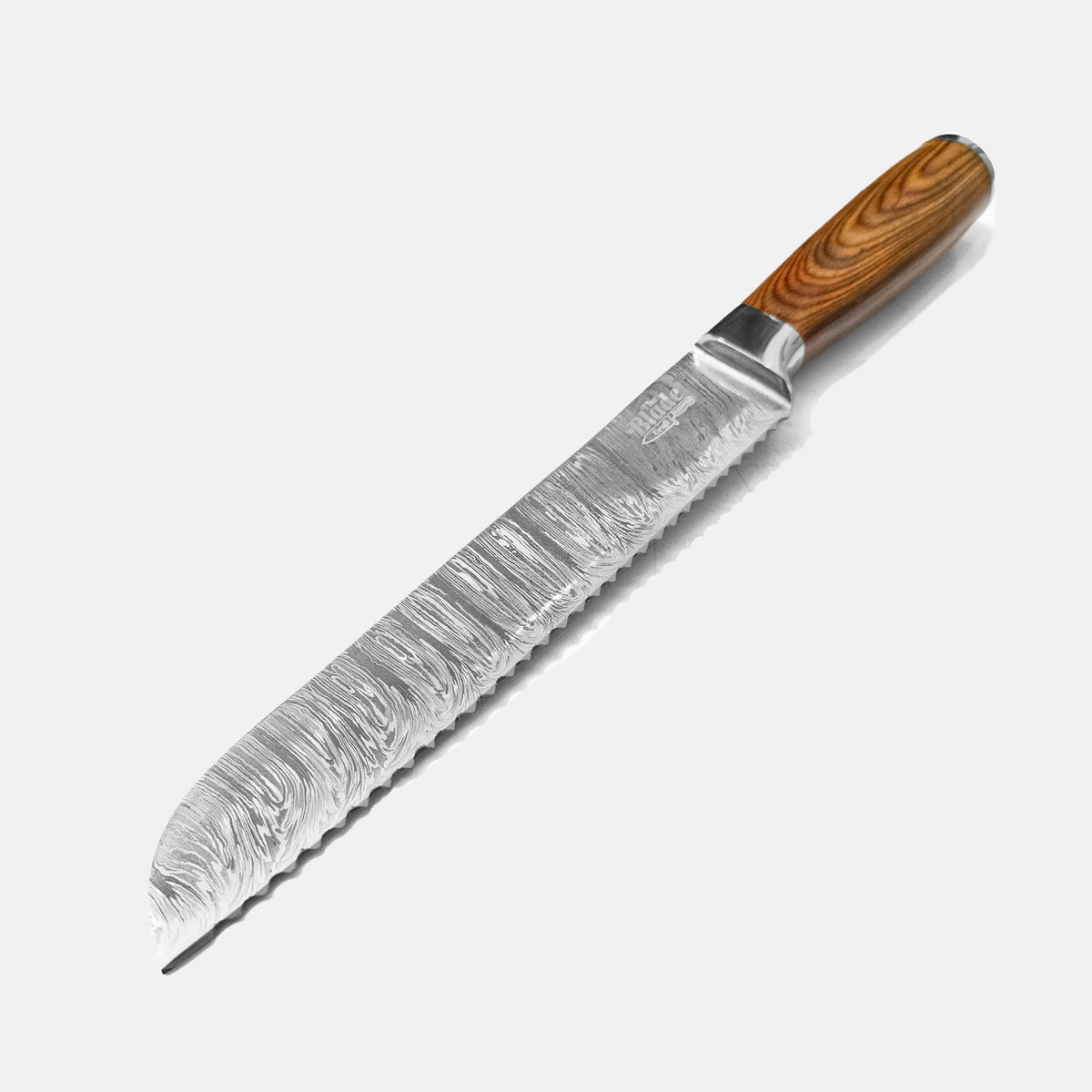
To sharpen a serrated knife, use a tapered ceramic or diamond sharpening rod. Find the side of the blade where the scallops are ground, match the rod to the size of each scallop, and file each one with a few light strokes at the same angle as the existing bevel. Finish by removing the small burr on the flat side. It takes about ten minutes, and a good bread knife only needs it every year or two.

Can you sharpen a serrated knife?
Yes. Many people assume a serrated knife has to be thrown away once it is dull, but each scallop is simply a small curved edge, and it can be sharpened like any other edge. The difference is the tool. A flat whetstone only touches the tips of the teeth, so it flattens them instead of sharpening the cutting curves inside.
The good news is that serrated knives dull slowly. The points of the teeth hit the board first and protect the edge inside each scallop, which is why a bread knife keeps cutting long after a plain edge would have gone blunt.
What a serrated knife is used for
A serrated edge grips and saws through food with a hard outside and a soft inside. That makes it the right knife for crusty bread, sourdough and bagels, ripe tomatoes, citrus, peaches and plums, cakes and pastry, and sandwiches. See our serrated Damascus bread knives.
What you need
- A tapered sharpening rod. A ceramic or diamond rod that narrows towards the tip lets you match each scallop, large or small. This is the best tool for the job.
- A fine whetstone or a flat ceramic rod for removing the burr at the end.
- A marker pen (optional) to check that you are touching the whole bevel.
- Good light, so you can see each scallop.
Pull-through sharpeners with a serrated slot exist and are quick, but they treat the edge more roughly than a rod.
How to sharpen a serrated knife, step by step
1. Find the bevelled side
Look closely at both sides of the blade. On most serrated kitchen knives the scallops are ground on one side only, and the other side is flat. You sharpen the ground side and only lightly touch the flat side at the end.
2. Match the rod to the scallop
Slide the tapered rod into the first scallop until it fills the curve. The part of the rod that fits is the part you use for that scallop.
3. Hold the existing angle
Tilt the rod so it lies flat against the bevel of the scallop. Colouring the bevel with a marker helps: if the ink comes off evenly, your angle is right.
4. File each scallop
Push the rod through the scallop towards the edge with light pressure, three to five strokes per scallop. Move along the blade one scallop at a time. Do not try to grind out nicks; you only need to refresh the edge.
5. Check for a burr
Run a fingertip gently across the flat side, moving away from the edge. A slight roughness means that scallop is sharpened through.
6. Remove the burr
Lay the flat side of the blade completely flat on a fine whetstone or ceramic rod and make two or three light passes. Keep it flat: angling it would create a new bevel on the flat side.
7. Test
Slice a tomato or the crust of a loaf. A sharp serrated knife bites straight in without needing to be pushed down.
How do you know a serrated knife needs sharpening?
- It slides on tomato skin or crust instead of biting in.
- You have to press down to cut bread, and the loaf gets squashed.
- Slices of bread tear or leave a lot of crumbs.
How often should you sharpen a serrated knife?
Much less often than a plain edge. For a home kitchen, once every year or two is typical, depending on use. Unlike a chef knife, a serrated knife does not need regular honing.
Mistakes to avoid
- Using a flat whetstone on the serrations. It wears down the tips of the teeth.
- Using a rod that is too thick for small scallops, which widens and reshapes them.
- Sharpening the flat side at an angle. Only remove the burr, keeping the blade flat.
- Pressing hard. Light strokes keep the scallops even.
- Using a powered grinder. It removes far too much steel.
Keep it sharp for longer
Cut on wood or plastic, never on glass, slate or stone. Wash by hand and dry straight away, and store the knife in a block, on a magnetic strip or in a guard. For plain-edged knives, see our guide to sharpening with a whetstone.
Frequently asked questions
Can you sharpen a serrated knife with a regular sharpener?
Only if it has a slot made for serrated edges. A standard V-slot sharpener will flatten the teeth.
Can a serrated bread knife be sharpened on a whetstone?
Only the flat side, to remove the burr. The serrations themselves need a round rod.
Is it worth sharpening a cheap serrated knife?
Thin, soft steel loses its edge again quickly, so the effort rarely pays off. A hardened blade, such as our PrimeCut 7.9-inch Damascus bread knife, holds its serrations for years between sharpenings.
Why do bread knives stay sharp so long?
The tips of the teeth take the contact with the board, so the cutting edges inside the scallops are protected.
Hand-forged in 224 layers
Find the right knife for the job
Every Blade Craft knife is forged by hand from Damascus steel, finished with a full-tang handle and covered by our lifetime guarantee.