Knife guide · 3 min read
What Is a Santoku Knife Used For?
The santoku is Japan's all-purpose kitchen knife. Here is what it is used for, how to cut with it, and how it compares with a chef knife and a nakiri.
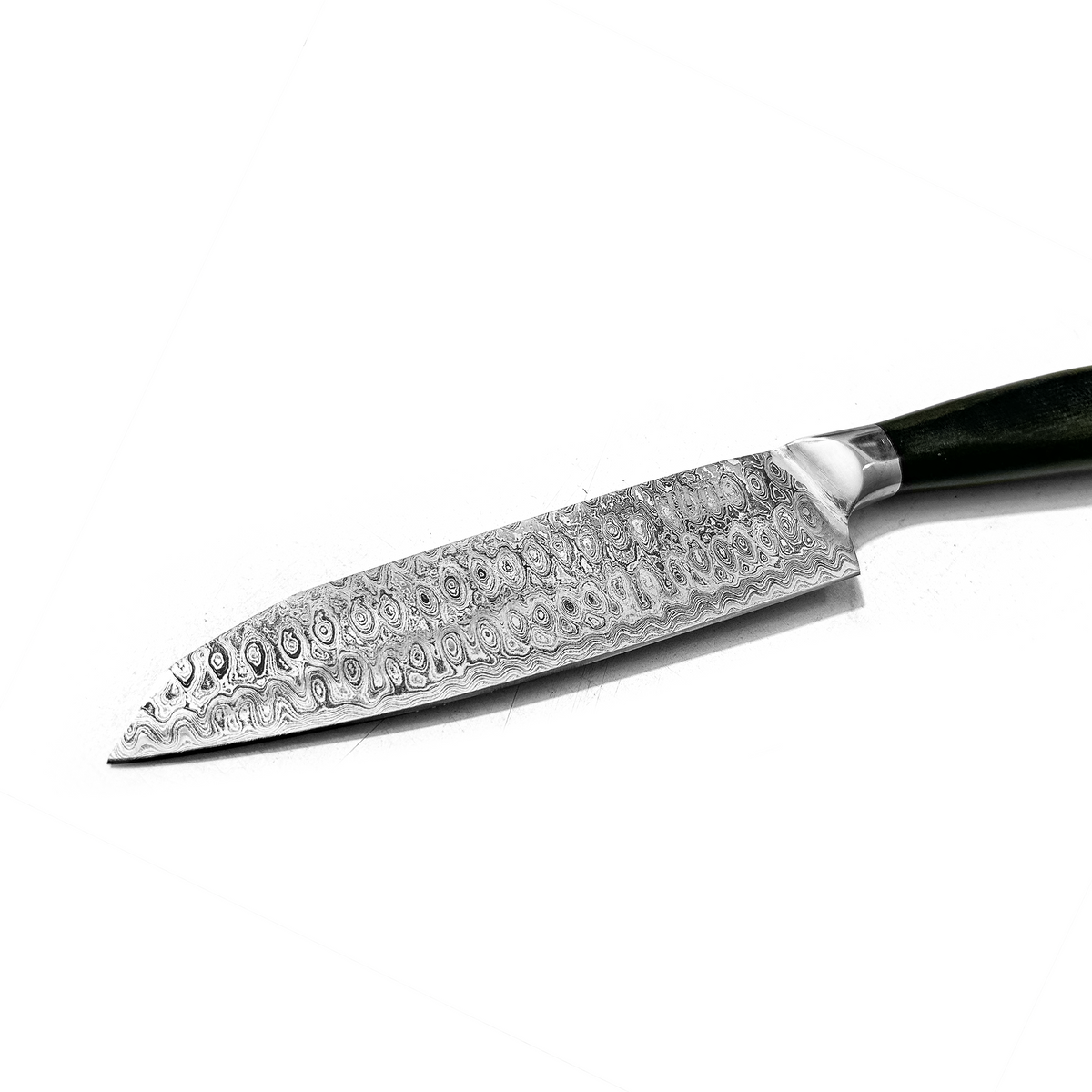
A santoku knife is used for slicing, dicing and mincing vegetables, boneless meat and fish. It is the general-purpose knife of the Japanese home kitchen, and for many cooks it does the same job as a Western chef knife in a shorter, lighter shape.
What "santoku" means
Santoku is usually translated as "three virtues" or "three uses". Some read that as slicing, dicing and mincing, and others as meat, fish and vegetables. Either way the idea is the same: one knife for most of what you cut.
What a santoku looks like
- Length: usually 5 to 7 inches (13 to 18 cm), shorter than most chef knives.
- Edge: flatter than a chef knife, with only a slight curve towards the tip.
- Tip: the spine curves down to meet the edge in a rounded "sheep's foot" shape, with no long pointed tip.
- Blade: wide and fairly thin, which helps with fine slices and with scooping food off the board.
What a santoku is good at
- Vegetables. The flat edge meets the board along most of its length, so onions, carrots, peppers and cabbage are cut right through in one stroke.
- Boneless meat and poultry. Slicing chicken breast, cutting stir-fry strips and dicing meat.
- Fish. Portioning fillets and slicing boneless fish.
- Fine work. Mincing garlic, ginger and herbs, and cutting thin, even slices.
What not to use it for
A santoku has a thin, hard edge. Do not use it on bones, frozen food or very hard squash, and do not twist it in a cut. Use a cleaver for bones and a serrated bread knife for crusty loaves.
How to cut with a santoku
A chef knife is rocked on its curved edge. A santoku works best with a push cut: start with the blade slightly forward, then move it down and away from you in one motion, lifting it clear of the board between cuts. A straight up-and-down chop also works for softer vegetables. Keep your guiding hand in a claw shape with the knuckles against the flat of the blade.
Santoku vs chef knife
| Santoku | Chef knife | |
|---|---|---|
| Typical length | 5 to 7 in | 8 to 10 in |
| Edge | Flatter | Curved |
| Cutting motion | Push cut or chop | Rocking |
| Tip | Rounded | Pointed |
| Best for | Vegetables, precise slices, small boards | Large items, herbs, all-round prep |
Choose a santoku if you cook a lot of vegetables, like a lighter knife or have a small chopping board. Choose a chef knife if you like to rock the blade or often cut large items. We compare the two in more depth in Chef Knife vs Santoku.
Santoku vs nakiri
A nakiri has a fully flat edge and a squared-off end, and is made only for vegetables. A santoku has a slight curve and a tip, so it also handles meat and fish. If you want one knife, the santoku is the more versatile of the two.
What size santoku should I buy?
Seven inches (18 cm) suits most adults and handles everything from an onion to a small cabbage. Around six inches is easier to control if you have smaller hands or limited board space.
Frequently asked questions
Can a santoku replace a chef knife?
For most home cooking, yes. The two overlap almost completely. The chef knife has the advantage on very large items and for rocking through herbs.
Is a santoku good for cutting meat?
Yes for boneless meat, poultry and fish. It is not for cutting through bone.
Why do some santoku knives have dimples?
The hollows along the blade, called a granton edge, let a little air in between the blade and the food so that slices release more easily.
Our Damascus santoku knives are forged from 224 layers of steel, with 6 to 7 inch blades and a choice of handles.
Hand-forged in 224 layers
Find the right knife for the job
Every Blade Craft knife is forged by hand from Damascus steel, finished with a full-tang handle and covered by our lifetime guarantee.