Knife guide · 4 min read
What Is Damascus Steel? How It Is Made and Why It Matters in a Kitchen Knife
Damascus steel is layered steel with a flowing pattern. Here is how it is made, how to tell real from fake, and what it means for a kitchen knife.
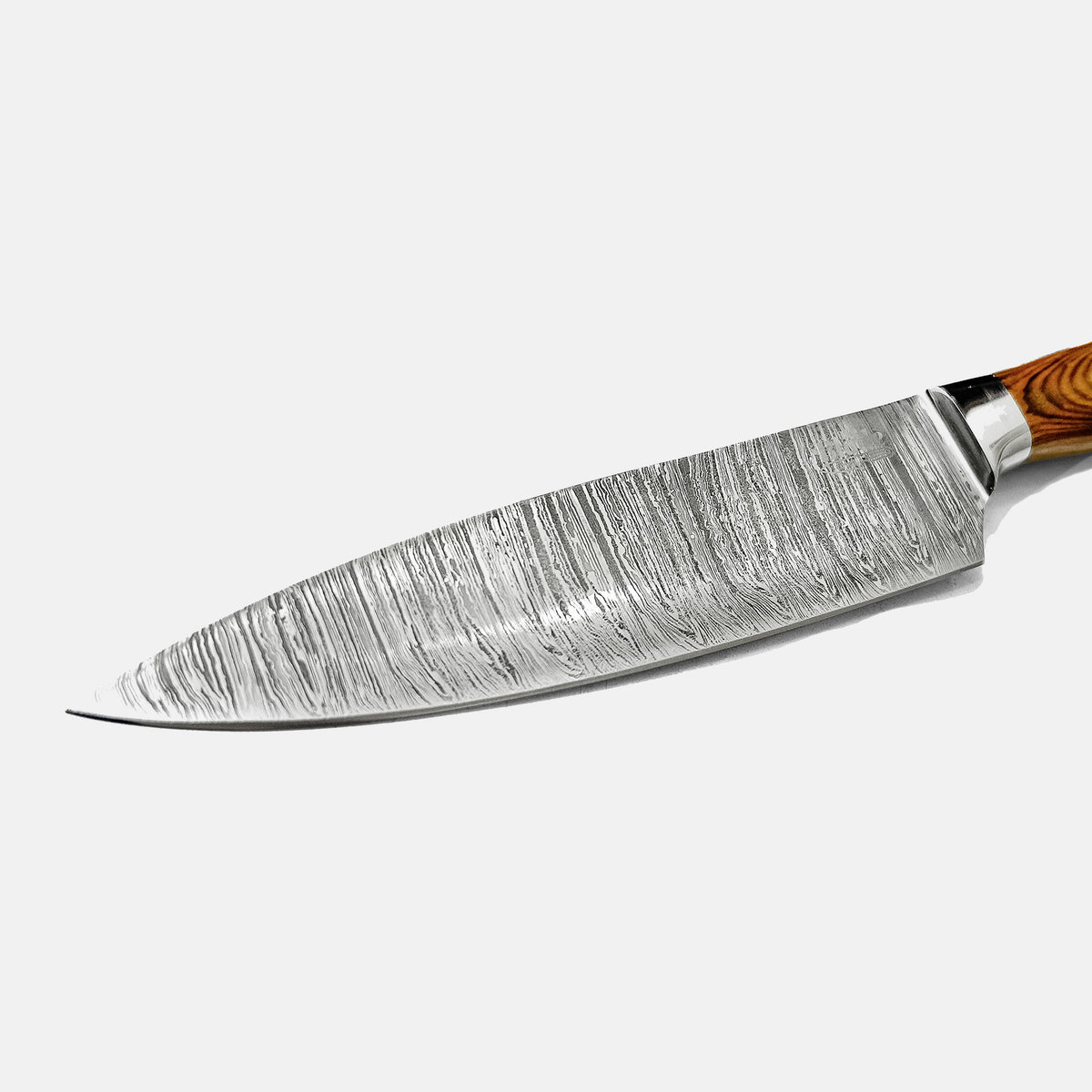
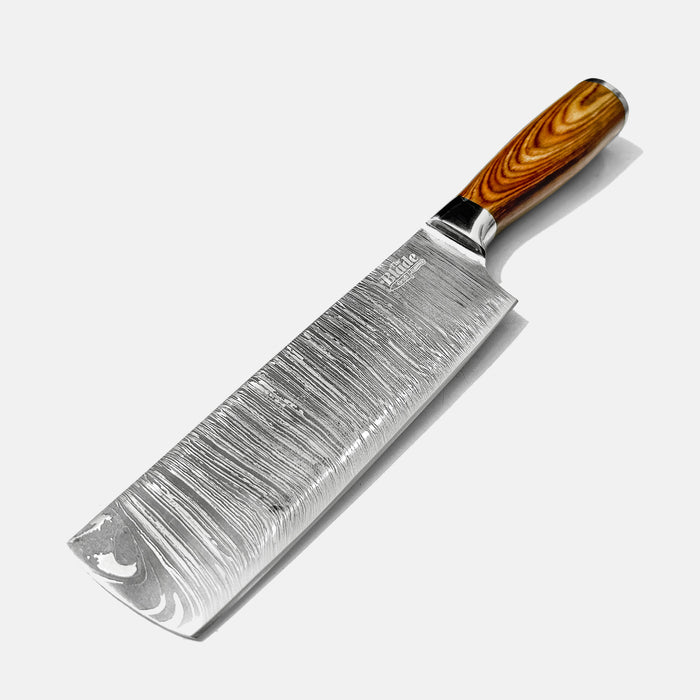
Damascus steel is steel made from many layers of two or more different steels, forge-welded together and etched in acid so that the layers show as a flowing, wavy pattern. In a kitchen knife it combines a hard steel that holds an edge with a tougher steel that resists chipping. The pattern is part of the metal, so it is different on every blade.
Where the name comes from
The name goes back to blades traded through Damascus, in Syria, many centuries ago. Those blades were forged from wootz, a crucible steel made in India and Sri Lanka, and were known for a watery surface pattern and a very keen edge. The exact method for making wootz blades was lost by around the 1800s.
What is sold as Damascus steel today is pattern-welded steel. It looks similar and is made in a different way: by stacking and welding layers instead of casting a single ingot. Almost every modern Damascus knife, from any maker, is pattern-welded.
How Damascus steel is made
- Stack. Thin plates of two different steels are stacked in alternating layers.
- Forge-weld. The stack is heated until it glows and hammered so the plates fuse into one solid bar.
- Fold or restack. The bar is drawn out, cut or folded, and welded again. Each round multiplies the number of layers.
- Shape and heat-treat. The bar is forged into a blade, then hardened and tempered.
- Etch. The finished blade is dipped in acid. The two steels react differently, so one darkens more than the other and the pattern appears.
Our own knives use 224 layers of AISI 5160 high-carbon steel and AISI 4340 nickel alloy steel. The high-carbon steel gives the edge, and the nickel alloy adds toughness and the bright lines in the pattern.
Is Damascus steel good for kitchen knives?
Yes, when it is made from good steels and properly heat-treated. The layering itself does not make a knife sharper. What decides performance is the steel at the cutting edge and how hard it has been made, which is measured on the Rockwell scale (HRC). A well-made Damascus knife takes a fine edge, keeps it through months of home cooking and has some flex in the blade instead of being brittle.
The honest trade-off is care. Damascus made with high-carbon steel can mark or rust if it is left wet, so it needs to be washed and dried by hand. In return you get a blade that is easy to sharpen and looks like nothing else in the kitchen.
Does the number of layers matter?
Mostly for looks. More layers give a finer, denser pattern, and fewer layers give broad, bold bands. Many knives have 67 layers. A higher count takes more forging work, but it does not by itself make the knife cut better. If a seller talks only about layer count and will not tell you the steels or the hardness, ask.
How to tell real Damascus from fake
- Check the spine and the edge. On real layered steel, fine lines continue over the spine and into the sharpened bevel. A printed or laser-etched pattern stops at the flat of the blade.
- Compare two knives. Real patterns never repeat exactly. Identical patterns across a listing mean the pattern was printed.
- Look at the price. Forging layered steel takes time. A large "Damascus" chef knife for the price of a takeaway is almost certainly not layered steel.
How to look after Damascus steel
- Wash by hand and dry straight away. Never use a dishwasher.
- Cut on wood or plastic, not glass, marble or slate.
- Store in a block, on a magnetic strip or in a blade guard.
- Wipe on a little food-safe mineral oil if the knife will sit unused for a while.
- Hone every few uses and sharpen on a whetstone when honing stops working.
A soft grey patina over time is normal and helps protect the steel.
Frequently asked questions
Is Damascus steel stronger than normal steel?
Not automatically. It is as strong as the steels in it and the heat treatment allow. Its advantage is the combination of a hard edge steel with a tougher steel, plus the pattern.
Does Damascus steel rust?
It can if it contains high-carbon steel and is left wet. Dry it after washing and it will not be a problem.
Is modern Damascus the same as ancient Damascus?
No. Ancient Damascus was made from wootz crucible steel. Modern Damascus is pattern-welded from layers of different steels.
To see layered steel in practice, browse our hand-forged Damascus kitchen knives, or start with a Damascus chef knife.
Hand-forged in 224 layers
Find the right knife for the job
Every Blade Craft knife is forged by hand from Damascus steel, finished with a full-tang handle and covered by our lifetime guarantee.