-
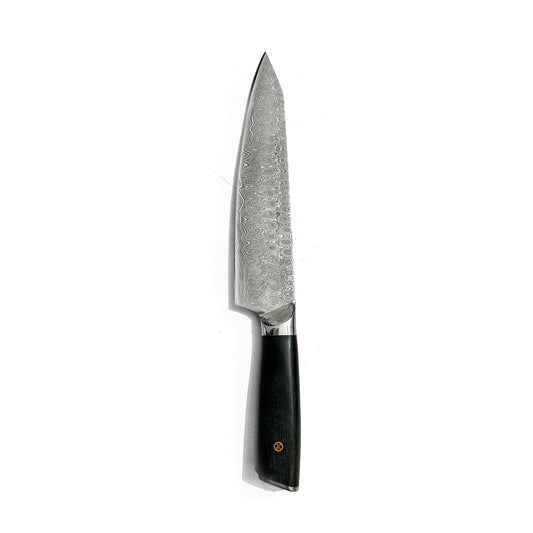
TitanForge 7.7" Damascus Chef Knife
Normaler Preis £92.00 GBPNormaler Preis -
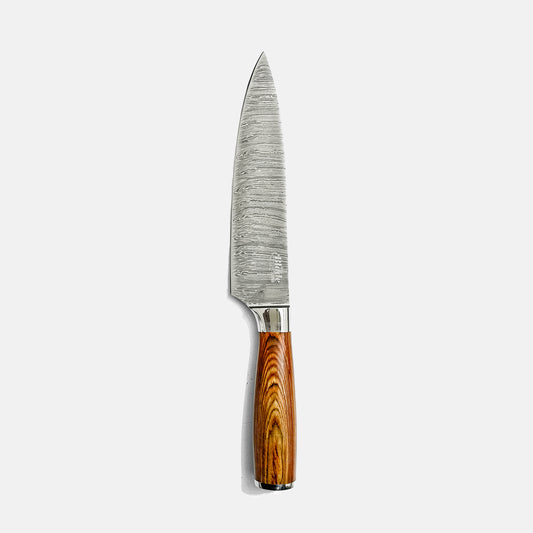
PrimeCut 8" Damascus Chef Knife
Normaler Preis £98.00 GBPNormaler Preis -
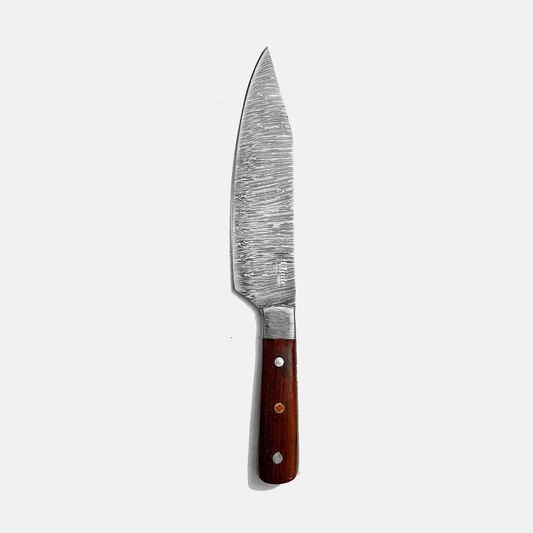
SteelPulse 7.5" Damascus Chef Knife
Normaler Preis £94.00 GBPNormaler Preis -
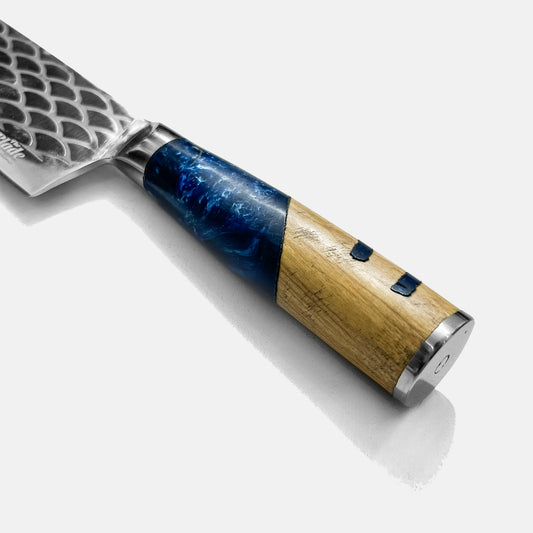
BladeWave 8" Damascus Chef Knife
Normaler Preis £102.00 GBPNormaler Preis -
SharpCraft 8.1" Damascus Chef Knife
Normaler Preis £92.00 GBPNormaler Preis





The buyer's guide
What is a Damascus chef knife?
A Damascus chef knife is an all-purpose kitchen knife with a blade made from layers of steel forged together. The blade is then etched in acid, which darkens some layers more than others and brings out the wavy pattern. The chef knife shape, around 20cm with a curved edge and pointed tip, handles most kitchen prep: chopping, slicing, dicing and mincing.
The name comes from the swords traded through Damascus centuries ago. Those were made from wootz, a crucible steel from India and Sri Lanka, and the method was lost by the 1800s. Today's Damascus is pattern-welded steel: two or more steels, usually a hard high-carbon steel and a softer, tougher one, are stacked, forge-welded and folded until they bond into one bar. That bar is then shaped into a blade.
Does layer count matter? 67 vs 224 layers
Layer count mainly changes how the pattern looks, not how well the knife cuts. More layers give a tighter, finer ripple. Fewer layers give broad, bold bands.
A lot of Damascus knives sold in the UK have 67 layers: 33 on each side of a central core, plus the core itself. Ours have 224, which gives a denser pattern and takes more forging to produce. It's a real difference, but it's mostly visual.
What decides cutting performance is the steel at the edge and how it has been heat-treated. That shows up in the hardness rating, measured on the Rockwell C scale (HRC):
- 54–58 HRC: typical of German-style knives. Tough and easy to sharpen, but the edge dulls sooner.
- 58–61 HRC: a middle ground. Holds an edge well without being brittle.
- 60–63 HRC: typical of Japanese knives. Very sharp for a long time, but more likely to chip if twisted or used on bone.
Our chef knives are hardened to over 56 HRC. That puts them at the tougher end of the scale: the edge is less likely to chip and is quick to bring back on a honing rod or whetstone, and it will need touching up a little sooner than a very hard Japanese blade.
If a seller quotes a layer count but won't tell you the hardness or the edge steel, ask why.
How to tell real Damascus steel from fake
- Look at the spine. On real layered steel, you can see fine lines running along the back of the blade. A printed pattern stops at the flat face.
- Look at the edge bevel. When the edge is sharpened, real layers show as thin lines in the bevel. On a fake, the bevel is plain, shiny steel.
- Compare two knives of the same model. Real Damascus never repeats exactly. If every knife in the listing has an identical pattern, it's printed.
- Check the price. Layered steel takes time to forge. A 20cm "Damascus" chef knife for £15 is almost certainly fake.
- Ask for the specs. A genuine seller can tell you the edge steel, the hardness and the layer count.
How to choose the best Damascus chef knife
Blade length
20cm (8in) suits most home cooks. Go for 19cm if you have smaller hands or a small chopping board. Choose 21cm or longer if you often cut large squash, whole cabbages or roasting joints.
Weight and balance
A heavier knife does more of the work on hard vegetables. A lighter one is less tiring during long prep sessions. Hold it with a pinch grip, thumb and forefinger on the blade just in front of the handle. If it balances there, it will feel controlled.
Handle
Wood looks warm but needs an occasional wipe of oil and shouldn't soak. G10 and resin handles aren't affected by water. Either way, look for a full tang, where the steel runs the whole length of the handle, for strength and balance.
Hardness
Harder steel (60 HRC and above) stays sharp longer but needs gentler handling. Softer steel is more forgiving and quicker to sharpen. Whatever the hardness, a chef knife isn't for bones or frozen food. Use a cleaver or boning knife for those.
Budget
- Under £40: often a printed pattern or soft, unbranded steel.
- £80–£150: real layered steel with stated hardness. This is where our range sits.
- £300 and up: named makers hand-forging each blade. Boutique makers such as Nesmuk charge from several hundred euros to several thousand.
Quick picker: for your first good knife, choose the PrimeCut 20cm. For smaller hands, the SteelPulse 19cm. For big batch cooking, the SharpCraft 21cm.
Our five chef knives compared
| Knife | Blade | Handle and finish | Price |
|---|---|---|---|
| SteelPulse | 7.5 in (19 cm) | Riveted rosewood | £94 |
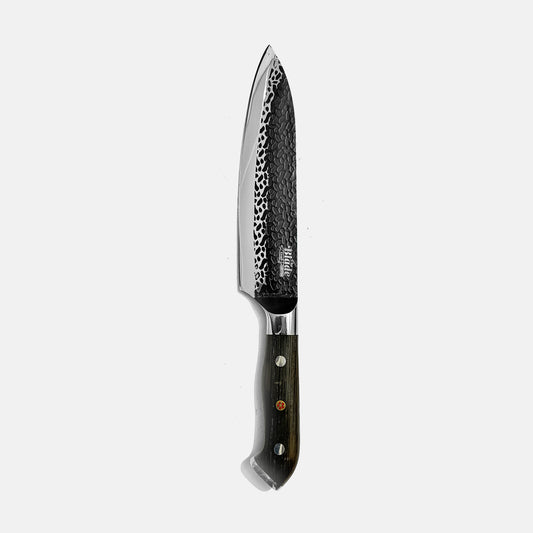
| TitanForge | 7.7 in (19.5 cm) | Black handle | £92 |
| PrimeCut | 8 in (20 cm) | Riveted wood | £98 |
| BladeWave | 8 in (20 cm) | Blue resin and wood, fish-scale blade | £102 |
| SharpCraft | 8.1 in (20.6 cm) | Dark wood, hammered blade | £92 |
How to look after a Damascus knife
- Hand wash and dry it straight away. A dishwasher's heat, strong detergent and knocks will dull the edge, fade the pattern and damage the handle.
- Don't leave it wet. The high-carbon layers can spot with rust. If you're storing it for a while, wipe on a thin coat of food-safe mineral oil.
- Use a wood or plastic board. Glass, marble and slate boards blunt an edge in minutes.
- Store it safely. Use a block, a magnetic strip (spine first) or a blade guard, never loose in a drawer.
- Hone often, sharpen rarely. A few strokes on a ceramic honing rod every couple of uses keeps the edge straight. Sharpen on a whetstone, 1000 grit then 6000 grit, keeping the same angle on both sides, every two to four months for home use.
- Expect some patina. A light grey or blue tint on the steel over time is normal and protects the blade. If the pattern fades after years of use, the blade can be re-etched. Ask us before trying it at home.
Buying a knife online in the UK
You must be 18 or over to buy a knife anywhere in the UK. Under the Offensive Weapons Act 2019, knives sent to a home address can only be handed to someone aged 18 or over. The courier may ask for photo ID.
The Blade Craft, Nortex Business Centre, 105 Chorley Old Road, Bolton BL1 3AS. Questions about a knife? Email support@thebladecraft.com.
Damascus chef knife FAQs
Are Damascus chef knives worth it?
Yes, if the steel is genuine and the hardness is stated. A good Damascus chef knife cuts as well as a plain high-end knife and holds its edge for months of home use. You're also paying for the pattern, which is unique to each blade. Avoid cheap knives with a printed pattern.
What size Damascus chef knife should I buy?
A 20cm (8in) blade suits most home cooks. It's long enough for large vegetables and still easy to control. Choose 19cm if you have smaller hands or a small board, and 21cm if you often cut big squash or roasting joints.
Is Damascus steel better than stainless steel?
Many Damascus knives use a high-carbon core, which takes a keener edge and holds it longer than most stainless steel. Stainless resists rust better and needs less care. Our blades pair a hard core with tougher outer layers, so you get a fine edge with everyday durability — just hand wash and dry them.
Do Damascus knives rust?
They can spot if left wet, because some layers contain high-carbon steel. Wash by hand, dry straight away and store dry. If you won't use the knife for a while, wipe on a thin coat of food-safe mineral oil. A grey or blue patina is normal and isn't rust.
How can I tell if a Damascus knife is real?
Look at the spine and the edge bevel. On real Damascus, thin layer lines show on both. A printed pattern stops at the flat face and never shows in the bevel. Real patterns also vary from knife to knife, so identical patterns across one listing are a warning sign.
Can Damascus knives go in the dishwasher?
No. Heat, strong detergent and knocks against other items dull the edge, fade the pattern and damage the handle. Wash by hand with warm water and washing-up liquid, then dry with a towel. It takes under a minute.
How often should I sharpen a Damascus chef knife?
For home use, sharpen on a whetstone every two to four months, working from 1000 grit to 6000 grit and keeping the same angle on both sides. Between sharpenings, a few strokes on a ceramic honing rod every couple of uses keeps the edge straight.
Do I need ID to buy a knife online in the UK?
You must be 18 or over to buy a knife in the UK. Under the Offensive Weapons Act 2019, knives sent to a home address can only be handed to an adult, so the courier may ask for photo ID.
Is a Damascus chef knife a good gift?
Yes. It's something people use every day, and the pattern makes each one different. Each knife arrives in a presentation box. For a gift, a 20cm blade like the PrimeCut is the safest choice, since it suits most cooks.