Knife guide · 3 min read
Nakiri vs Santoku: Which Japanese Knife Should You Buy?
Nakiri vs santoku: how they differ in shape and cutting style, what a nakiri is used for, and which one suits your cooking.

A nakiri is a vegetable knife with a flat edge and a squared-off end. A santoku is an all-purpose knife with a slightly curved edge and a rounded tip. Choose a nakiri if most of what you cut is vegetables; choose a santoku if you want one knife that also handles meat and fish.

Nakiri vs santoku at a glance
| Nakiri | Santoku | |
|---|---|---|
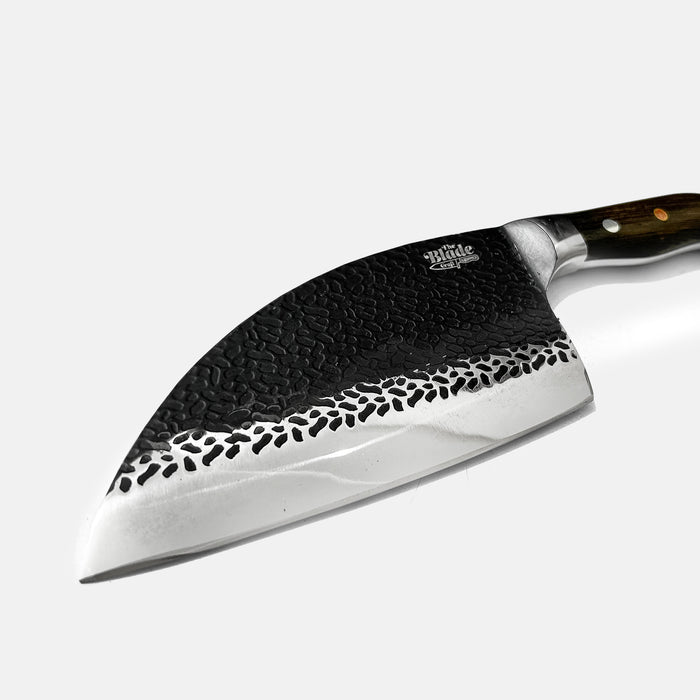
| Blade shape | Rectangular, squared tip | Wide, rounded "sheep's foot" tip |
| Edge | Completely flat | Mostly flat, slight curve near the tip |
| Cutting motion | Push cut or straight chop | Push cut, chop, light rocking |
| Best for | Vegetables and herbs | Vegetables, boneless meat, fish |
| Typical length | 6 to 7 in | 6 to 7 in |
| One-knife kitchen? | No, a specialist | Yes |
What is a nakiri knife used for?
A nakiri is the Japanese vegetable knife. Because its edge is completely flat, the whole edge meets the board at the same moment, so every cut goes cleanly through. You do not get the strings of half-cut onion or spring onion that a curved blade can leave. It is ideal for:
- Shredding cabbage and lettuce
- Slicing onions, carrots and peppers thinly and evenly
- Chopping herbs and spring onions
- Cutting through squash and large root vegetables
- Fine julienne and dice
The tall, flat blade also guides against your knuckles and works as a scoop to carry food to the pan.
What is a santoku used for?
The santoku is Japan's all-purpose kitchen knife: slicing, dicing and mincing vegetables, boneless meat and fish. Its slight curve and pointed-down tip let it do detail work a nakiri cannot. We cover it fully in what is a santoku knife used for.
How to use a nakiri knife
- Push cut: start with the blade slightly forward and push down and away in one motion, so the edge slides through.
- Straight chop: for softer vegetables, bring the blade straight down and lift it clear between cuts.
- Don't rock it. The flat edge is not made for the rocking motion of a chef knife.
- Keep your guiding hand in a claw with your knuckles against the flat of the blade.
Which should you buy?
- You cook mostly vegetables, or you are vegetarian: a nakiri, such as our PrimeCut 7-inch Damascus nakiri.
- You want one knife for everything: a santoku.
- You already own a chef knife or santoku: a nakiri is the natural second knife, because it is faster and cleaner on vegetables.
Nakiri vs chef knife
A chef knife is longer and curved for rocking, with a pointed tip. It is more versatile but leaves more uneven cuts on vegetables. A nakiri does one job, vegetables, better than any other knife. See our chef knives and our guide to the types of kitchen knives.
Frequently asked questions
Can a nakiri cut meat?
It will slice boneless meat, but it is not designed for it, and it must never be used on bone, which can chip the thin edge.
Is a nakiri good for beginners?
Yes. The flat edge and straight cutting motion are easy to learn, and the tall blade keeps fingers away from the edge.
What is the difference between a nakiri and a usuba?
Both are Japanese vegetable knives. A nakiri is sharpened on both sides and suits home cooks. A usuba is sharpened on one side only and is mainly a professional's knife.
Do I need both a nakiri and a santoku?
No. Start with the santoku for versatility, then add a nakiri if vegetables are most of what you cook.
Hand-forged in 224 layers
Find the right knife for the job
Every Blade Craft knife is forged by hand from Damascus steel, finished with a full-tang handle and covered by our lifetime guarantee.