Knife guide · 5 min read
How to Sharpen a Knife with a Whetstone: A Step-by-Step Guide
How to sharpen a kitchen knife on a whetstone, step by step: which grit to use, what angle to hold, and how to tell when the edge is done.
To sharpen a knife with a whetstone, soak the stone if it needs it, hold the blade at a steady angle of roughly 15 to 20 degrees, and push the edge across a medium-grit stone until you feel a burr along the whole blade. Repeat on the other side, then refine the edge on a fine-grit stone. The steps below take about 15 minutes once you have done it a few times.
What you need
- A whetstone. A combination stone with 1000 grit on one side and 3000 to 6000 grit on the other is enough for home use.
- Water. Most whetstones are water stones. Some need soaking, and some only need a splash, so check the maker's instructions.
- A damp cloth or a stone holder to stop the stone sliding.
- A towel for wiping the blade.
Which grit should I use?
| Grit | Use |
|---|---|
| 200 to 600 (coarse) | Repairing chips or a very blunt edge |
| 800 to 2000 (medium) | Normal sharpening. 1000 is the standard |
| 3000 to 8000 (fine) | Refining and polishing the edge |
For a knife that is dull but undamaged, start at 1000 and finish at 3000 to 6000.
How to sharpen a knife on a whetstone
Step 1: Prepare the stone
If your stone needs soaking, put it in water until the bubbles stop, usually 10 to 15 minutes. Set it on a damp cloth with the medium grit facing up and keep the surface wet throughout.
Step 2: Find your angle
Most kitchen knives are sharpened at roughly 15 to 20 degrees per side. Lay the blade flat on the stone, then lift the spine until there is a gap of about two stacked coins beneath it. Holding the same angle on every stroke matters more than the exact number.
Step 3: Sharpen the first side
Hold the handle in one hand and rest the fingertips of the other on the flat of the blade, near the edge. With light, even pressure, push the knife away from you across the stone as if you were slicing a thin layer off the top, moving from heel to tip. Ease the pressure on the way back. Work in sections if the blade is longer than the stone is wide.
Step 4: Check for a burr
After 10 to 20 strokes, carefully run a thumb across the opposite side of the edge, moving away from the edge and never along it. You should feel a slight roughness, called a burr, along the full length. The burr tells you that side is done. If it is missing in places, work those sections again.
Step 5: Sharpen the second side
Turn the knife over and repeat at the same angle, with about the same number of strokes, until the burr forms on the first side.
Step 6: Refine on the fine grit
Flip the stone to the fine side and wet it. Repeat the process with lighter pressure and fewer strokes on each side. This removes the burr and polishes the edge. Finish with a few very light alternating strokes, one per side.
Step 7: Clean and test
Rinse and dry the knife and the stone. Test the edge on a sheet of paper or a ripe tomato. A sharp knife bites straight in without pressure and without slipping.
Common mistakes
- Changing the angle mid-stroke. This rounds the edge. Lock your wrist and move from the shoulder.
- Pressing too hard. Let the stone do the cutting.
- Letting the stone dry out. Add water whenever the surface looks dry.
- Skipping the burr check. Without a burr you cannot know that the two sides have met at the edge.
- Using a dished stone. Stones wear hollow over time. Flatten yours occasionally with a flattening plate.
Honing is not sharpening
A honing rod does not remove much metal. It straightens an edge that has bent slightly through use. Hone every few uses to keep a knife cutting well, and sharpen on a stone only when honing no longer brings the edge back. For most home cooks that is every two to four months.
Sharpening a Damascus knife
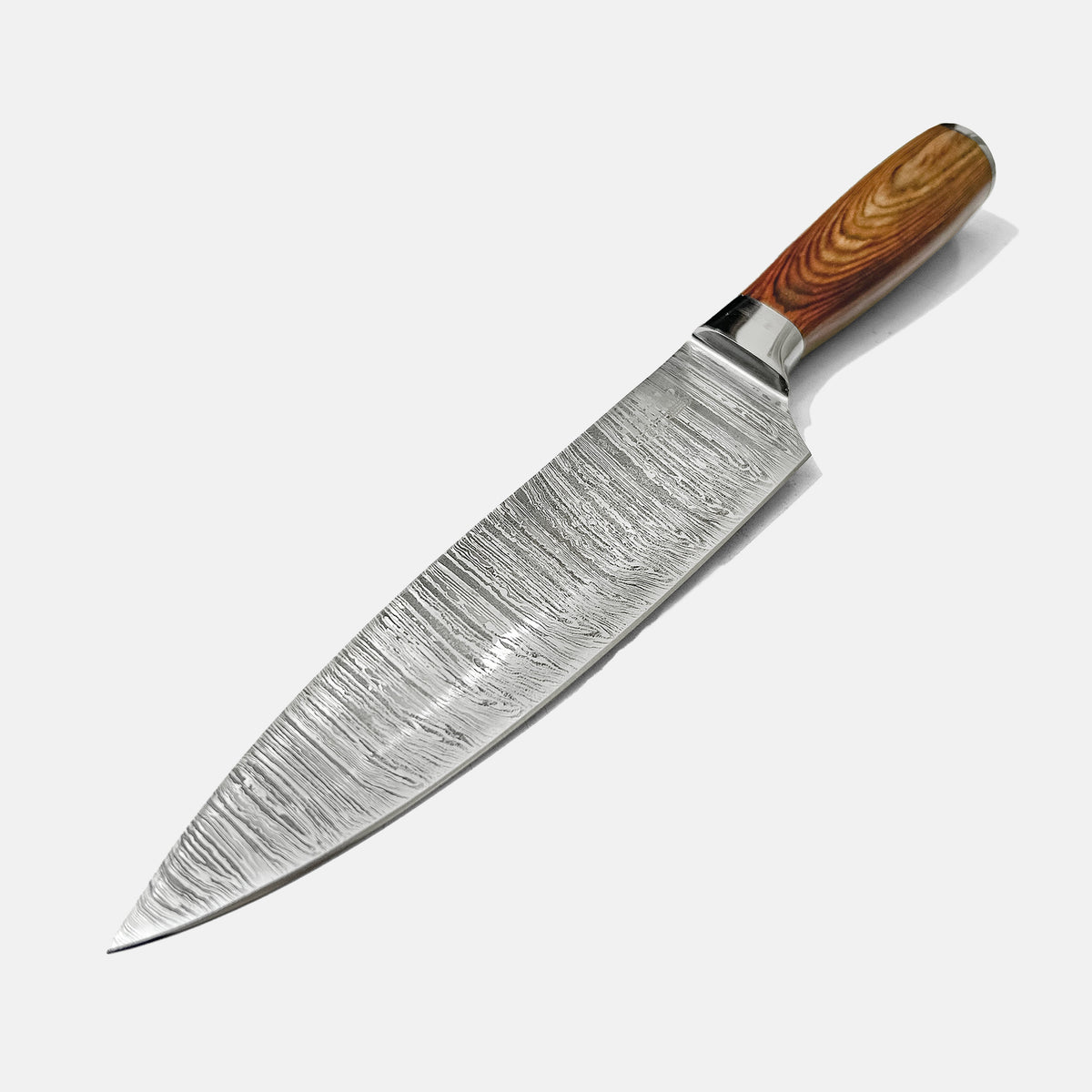
A Damascus knife is sharpened in exactly the same way. Sharpening only touches the narrow bevel at the edge, so the pattern on the flat of the blade is not affected. Avoid powered grinders and pull-through sharpeners, which remove far more steel than needed and can scratch the sides of the blade. After sharpening, wash and dry the knife straight away.
Knives you should not sharpen on a flat stone
Serrated knives, such as bread knives, need a tapered rod that fits each serration. They rarely need sharpening at all.
Frequently asked questions
How long should I soak a whetstone?
Until it stops releasing air bubbles, usually 10 to 15 minutes. Splash-and-go stones need no soaking. Follow the instructions that came with your stone.
What angle should I sharpen kitchen knives at?
Roughly 15 to 20 degrees per side. Thin Japanese-style blades are usually sharpened towards 15 degrees, and heavier Western knives and cleavers towards 20.
How often should I sharpen my knives?
For home use, every two to four months, with regular honing in between.
Is 1000 grit enough to sharpen a knife?
Yes. A 1000-grit edge is sharp enough for everyday cooking. A finer stone makes the edge smoother and helps it last longer.
A good edge starts with good steel. See our hand-forged Damascus chef knives and the full range.
Hand-forged in 224 layers
Find the right knife for the job
Every Blade Craft knife is forged by hand from Damascus steel, finished with a full-tang handle and covered by our lifetime guarantee.